The government is strong enough to keep the mob from monopolizing finance and kleptocratic enough to keep entrepreneurs from dominating the industry; but beyond that the police are hands off.
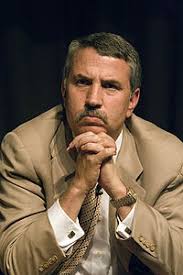 |
| Thomas Friedman, the NYT Bradley Gardner |
In his previous article, Gardner painted a rosy picture of the PRC leaving everybody alone, a veritable libertopia of commerce that
Liberation Daily touted Wenzhou as the model for the rest of China as far back as 1985, but claims that the recent alarm from the
Wall Street Journal and the
New York Times(!) are nothing to worry about. Apparently Gardner counts everybody with a hammer as a "factory owner" (his count of "factory owners" in the province of 3 Million is 400,000) so ninety of them fleeing after a government crackdown is nothing to worry about. If every "factory" really had only 7.5 workers, this might be nothing. Other opinions differ.
Has history been erased so well that even a former Libertarian standard bearer like
reason has forgotten scenes like this?
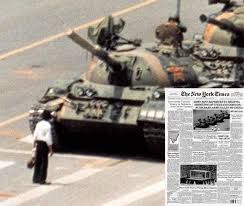 |
| Tank Man, 5 June 1989 |
 |
| Demolition of a Church in China |
Note that Gardner is a reporter
in Beijing, presumably with permission from the PRC. Perhaps the Shanghai Commies at
Liberation Daily (
Jiefang Daily?) were flying under the radar of the home office in Beijing in 1985?
Reason being, well,
reason, does not mention the state of religious freedom in Wenzhou. However, to be fair,
reason has never been big on that aspect of freedom, so one will not find the answer there. However, in 2000 the
Baltimore Sun knew what was
still happening in China with basic religious freedom:
The recent demolition campaign focused on several areas in Zhejiang Province, particularly Wenzhou, a city of more than 6 million people known for its energetic merchant class and deep religious roots. Protestant and Catholic missionaries began converting people in Wenzhou beginning in the latter part of the 19th century when the city became a treaty port. With more than 700,000 Protestants and several hundred thousand Catholics, it has a higher percentage of Christians than any other municipality in China.
China's state-run media rarely - if ever - publicize demolition campaigns because it only invites international condemnation. This time, though, the government gave some media a green light to report on the demolitions.
Late last month, the Wenzhou Daily reported that thousands of government employees and Communist Party cadres in Zhejiang's Ruian City demolished 28 unapproved "religious sites" and 356 small temples, occasionally using dynamite when needed. - The Baltimore Sun, Places of worship razed in Chinese crackdown, 15 December 2000, by By Frank Langfitt
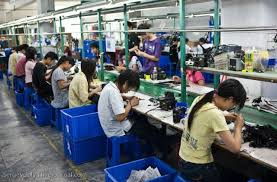 |
| Chinese factory workerss |
Make no mistake,
nothing has improved on that front. Note also that Christian missionaries to China from the United States still must take extensive precautions to avoid arrest. Mainland Chinese citizens who attend Churches in America frequently do so under assumed names and still live in fear of being found out by the PRC authorities.
Back to
reason, by the time 1989 rolled around, the pulp version of
reason was printing this about China:
The emergence of the American world nation also has profound ideological implications. The American message– stressing individual rights and private initiative–is gradually becoming universal and less linked to "white" ideology. Nowhere is this clearer than in China, where American cultural and political influence has a powerful appeal, particularly among the young. When 50,000 Chinese students demonstrated in Shanghai’s People’s Square in December 1986, they waved banners depicting the Statue of Liberty and a dragon bound in chains. Emblazoned on the banners were calls for such American-style values as democracy, human rights, and freedom. - Reason, America's Rising Sun, January 1989, by Joel Kotkin
So, how did
reason cover the Tienanmen Square protests five months later? With silence. No, really. They finally mentioned Tienanmen Square in a 1995 book review on non-violent protest. Apparently, as far as
reason is concerned, the demonstrations ignored by the PRC are the ones that count and the ones the tanks show up for are the ones that they do not bother mentioning, until 2009,
twenty years after the fact:
But the episode was not what it initially appeared to be: the end of China's evolution toward a more liberal system. It was only an interruption of that process. In the aftermath, the Chinese Communist Party grasped that it could hold onto power only by delivering a better life to its people, which it could achieve only by loosening its grip on their lives.
The rose colored bong continues to bubble at
1717 Pennsylvania Avenue Northwest. Like many who are blind to the wiley ways of Socialists, the
reason staff and contributors seem to be under the false illusion that having the liberty to chose what color shoes to wear on the way to the factory is freedom enough. As Jonah Goldberg has mentioned, the ROC murdered 67 million people before trying (crony) capitalism, and I will add that they have not even given a wink to the free market. It is only a matter of time before the people of Wenzhou get the treat of seeing how well their privately built roads hold up under the load of PRC tanks.
PBS's
FRONTLINE unarguably has a
much better grasp on the situation in China than
reason ever did, or will.
Almost two decades later, the educated elite who led the protests of 1989 have benefited handsomely from China's rapid economic growth, but many Chinese workers still face brutal working conditions and low wages. "A lot of factories do not even have one day off," says labor expert Dr. Anita Chan who has been researching working conditions inside China for 15 years. "That means seven days a week, 13 hours a day."
In fact, some experts see the emergence of two Chinas: one modern, wealthy and urban; the other rural, poor and disenfranchised. There is evidence that unrest among workers and peasants is growing; in 2005, there were more than 87,000 "civil disturbances" in the country.
A real success story, the Republic of China, aka, Taiwan began at the same time as the PRC with much better results. Perhaps Gardner and Friedman could take a little field trip there and see what they can find?


